
Stephen King's The Shining did not invent the haunted house story, the isolated-family drama, or the unreliable narrator. But it combined these elements in a way that was so effective, so commercially successful, and so culturally pervasive that it became the template — the DNA — from which decades of horror literature would be built. Trace the genre's evolution from 1977 to today, and you will find The Shining's fingerprints on nearly everything that matters. The novel's influence is not always direct, but it is always present, like a genetic marker passed down through generations.
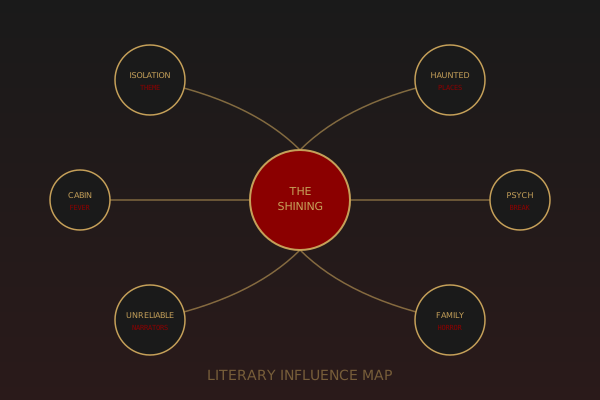
The Shining's literary influence map
The Haunted Building as Sentient Antagonist
Before The Shining, haunted house stories typically featured a building that was possessed by external evil — ghosts, demons, curses. The building was a container. Jackson's Hill House had begun to change this, making the house itself a presence, but King took the concept further. The Overlook Hotel is not merely haunted; it is alive, with desires, a history, and a will. The hotel wants Danny's power. The hotel uses Jack. The hotel is the antagonist.
This model — the building as sentient antagonist — has become a horror convention. From Marisha Enzlberger's sentient apartment buildings to Anne Rivers Siddons's The House Next Door to the haunted spaces of Mark Z. Danielewski's House of Leaves, the tradition of the building-as-character traces directly to King's Overlook. Even when contemporary horror writers are not consciously imitating King, they are working in a genre that he reshaped. The idea that a place can be evil — not just haunted by evil, but itself the source — is now a default assumption of the haunted house genre. That assumption was King's contribution.
Cabin Fever and the Isolated Family
The Shining's second major contribution is the trope of the isolated family descending into madness. King placed a small family in a remote location, cut off from the world, and watched them unravel. The isolation was both physical (the snowed-in hotel) and psychological (Jack's alcoholism, Wendy's codependency, Danny's psychic burden). The family's destruction came not from external attack but from internal rot amplified by confinement.
This "cabin fever horror" template has been endlessly replicated. The Cabin at the End of the World by Paul Tremblay, A Head Full of Ghosts (also Tremblay), The Terror by Dan Simmons, Bird Box by Josh Malerman — all place families or small groups in isolation and watch the pressure build. The Shining proved that confinement plus family dysfunction equals horror, and the genre has been mining that vein ever since. The trope is so established now that it is almost invisible. We accept that isolation is terrifying because King taught us to.
The Shining taught horror that the scariest monster is the one you are locked in with.On King's cabin fever legacy
The Addicted Protagonist
Jack Torrance is a recovering alcoholic, and his addiction is not a character detail — it is the mechanism of his destruction. The hotel works through Jack's drinking, his rage, his shame. Without the addiction, there is no novel. King's decision to make addiction the central vulnerability of his protagonist was revolutionary in 1977, and it opened horror to a new kind of character: the protagonist who is complicit in their own downfall.
Contemporary horror is full of addicted, traumatized, or mentally ill protagonists whose conditions are exploited by supernatural forces. The protagonist of Silvia Moreno-Garcia's Mexican Gothic is recovering from illness. The protagonist of Stephen Graham Jones's The Only Good Indians is haunted by guilt and substance abuse. The protagonist of Paul Tremblay's Survivor Song is a doctor in a pandemic. These characters all trace, in some way, to Jack Torrance — the broken man whose brokenness is the door the evil walks through.
The Psychic Child
Danny Torrance, the psychic child who sees what adults cannot, is another Shining innovation that became a genre staple. The child with special abilities — the "sensitive" who perceives the supernatural — existed before King (The Exorcist's Regan, for example), but King gave the psychic child interiority and agency. Danny is not a victim; he is a witness. He understands the threat, and his understanding gives the reader a window into the supernatural that the adult characters lack.
This trope — the child who sees more than the adults — is now everywhere. From The Sixth Sense to Stranger Things to Mike Flanagan's The Haunting of Hill House (the Netflix series), the psychic child is a convention. And while not all of these trace directly to The Shining, King's novel established the model: the child as seer, the child as vulnerable witness, the child whose power is both gift and curse. Danny Torrance's DNA is in every psychic child who has followed.
The Unreliable Father
Perhaps The Shining's deepest influence is its treatment of the father as threat. Jack Torrance is not a monster who breaks into the family. He is the family. He is the father, the protector, the man who is supposed to keep his wife and son safe — and he becomes the thing they must escape. This inversion of the protective father is one of horror's most powerful tropes, and King established it in its modern form.
Connected Reading
For a deeper look at The Shining itself, see our 50th anniversary analysis. For the King vs Kubrick debate, see our comparison article.
The Literary Ambition
Beyond specific tropes, The Shining's most lasting influence may be its demonstration that horror can be both popular and literary. King wrote a bestseller that was also a serious character study, a novel about addiction and family and American violence. He proved that horror did not have to choose between commercial success and artistic merit. This proof — that a horror novel could be taken seriously as literature — opened the door for every literary horror writer who followed.
The current horror renaissance, led by writers like Carmen Maria Machado, Victor LaValle, Stephen Graham Jones, and others, is a direct beneficiary of this legacy. These writers work in a genre that has been legitimized — and that legitimization began, in large part, with The Shining. King showed that horror could carry the weight of serious themes without sacrificing its power to terrify. Every literary horror novel published today is, in some sense, a response to that demonstration.
The Enduring DNA
The Shining's influence is not a matter of direct imitation. Most contemporary horror writers are not consciously copying King. But they are working in a genre that King reshaped, using tropes that King established or refined, and writing for readers whose expectations were set by The Shining. The novel's DNA is in the genre's bloodstream — invisible but everywhere. The haunted building, the isolated family, the addicted protagonist, the psychic child, the father as threat, the literary ambition — these are the building blocks of modern horror, and they all trace back, in some form, to a novel written in a Colorado hotel room in 1976.
The Shining influenced horror literature by showing what horror could be. It could be literary. It could be psychological. It could be about real human weakness exploited by supernatural forces. It could be both terrifying and artful. Once that was demonstrated, the genre could not go back. The Shining did not just influence horror. It redefined it. And fifty years later, the genre is still working through the implications of that redefinition — one haunted house, one broken family, one falling father at a time.