
Horror is a vast genre spanning three centuries of literature, and building a reading list that covers its full range can feel overwhelming. Where do you start? What do you read next? How do you move from the Gothic classics that founded the genre to the contemporary works redefining it? This guide is designed to answer those questions, offering a structured path through horror literature that is accessible to newcomers and rewarding for seasoned readers. Whether you have never read a horror novel or you have read hundreds, there is a path here for you.
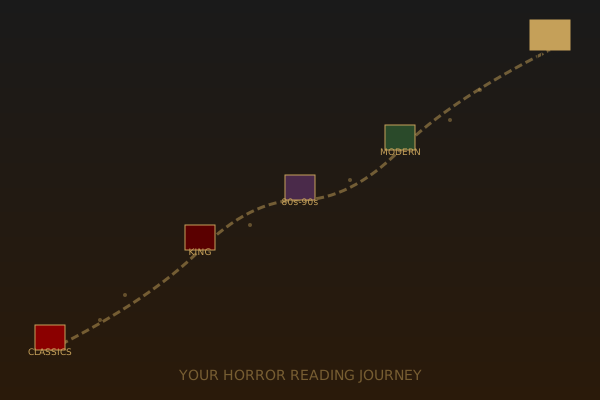
Your horror reading journey, mapped
Phase 1: The Gothic Foundations (1760s-1890s)
Every horror reading list should begin with the Gothic, the literary tradition that invented horror as we know it. The Gothic novel emerged in the 18th century with Horace Walpole's The Castle of Otranto (1764), the first novel to call itself a "Gothic story." From there, the tradition expanded through Ann Radcliffe, Matthew Lewis, and the German Schauerroman movement, reaching its first peak with Mary Shelley's Frankenstein (1818).
For a modern reader, the essential Gothic texts are fewer than you might think. Start with Frankenstein — still astonishing, still relevant, still the template for the "created monster" story. Then read Bram Stoker's Dracula (1897), the foundational vampire novel and a masterclass in epistolary structure. Add Robert Louis Stevenson's Strange Case of Dr. Jekyll and Mr. Hyde (1886) for its exploration of the double self, and Edgar Allan Poe's short stories for the invention of the psychological horror tale. These four works — Frankenstein, Dracula, Jekyll and Hyde, and Poe — give you the genetic code of horror. Everything that follows descends from them.
Read the Gothic not as homework but as archaeology. You are digging down to the roots of a living tradition.On reading the classics
Phase 2: The Psychological Turn (1950s-1960s)
The Gothic tradition dominated horror for nearly two centuries, but in the mid-20th century, horror took a psychological turn. The monsters did not disappear, but they moved inside. Shirley Jackson's The Haunting of Hill House (1959) is the essential text of this period — the novel that proved a haunted house story could be a literary character study. Jackson's influence on every haunted house novel that followed is incalculable.
Alongside Jackson, read Richard Matheson's I Am Legend (1954), which reimagined the vampire novel as post-apocalyptic survival horror. Add Robert Bloch's Psycho (1959), which brought the horror of the human mind to the mainstream. These three books — Hill House, I Am Legend, and Psycho — mark the moment horror became modern. They are short, fast, and terrifying, and they bridge the gap between the Gothic classics and the paperback boom that would follow.
Phase 3: The King Era (1970s-1980s)
The 1970s and 1980s were the Golden Age of horror paperbacks, and Stephen King was the era's defining voice. If you have not read King, start with The Shining (1977) — his third novel and still his best. From there, read Salem's Lot (1975) for the modern vampire story, Carrie (1974) for the telekinetic teenager, and The Stand (1978) for epic post-apocalyptic horror. If you want to go deeper, add It (1986) for King's masterpiece of small-town horror and childhood friendship.
Beyond King, the era produced other essential voices. Peter Straub's Ghost Story (1979) brought literary sophistication to the haunted house novel. Clive Barker's Books of Blood (1984-1985) introduced visceral, body-horror transgression. Robert McCammon's They Thirst (1981) offered a epic vampire siege of Los Angeles. Dean Koontz's Watchers (1987) blended horror with science fiction. Read two or three of these alongside King, and you will understand why this era was golden.
Beginner's Path
New to horror? Our beginner's reading list offers a curated 10-book journey from accessible modern classics to foundational Gothic texts, with reading order and rationale.
Phase 4: The Literary Renaissance (1990s-2000s)
After the paperback boom crashed in the early 1990s, horror went quieter and more literary. The essential texts of this period are fewer but significant. Mark Z. Danielewski's House of Leaves (2000) is a postmodern haunted house novel that uses typography, footnotes, and structural experimentation to create dread unlike anything before it. It is difficult, rewarding, and unlike any other horror novel.
Also essential: Cormac McCarthy's The Road (2006), which brought literary fiction's craft to post-apocalyptic horror. And in a different register, Joe Hill's Heart-Shaped Box (2007) proved that King's son could write horror as well as his father. The period also saw the rise of "domestic horror" — Gillian Flynn's Gone Girl (2012) and Sharp Objects (2006) brought the unreliable narrator to the thriller, blurring the line between horror and literary fiction.
Phase 5: The Contemporary Wave (2010s-Present)
The current horror renaissance is the most exciting period for the genre since the 1970s, and it is led by a diverse group of writers bringing new perspectives, new voices, and new terrors. Start with Victor LaValle's The Ballad of Black Tom (2016), a retelling of Lovecraft's "The Horror at Red Hook" from the perspective of a Black protagonist. Then read Stephen Graham Jones's The Only Good Indians (2020) for Indigenous horror that blends cultural identity with supernatural dread.
Add Silvia Moreno-Garcia's Mexican Gothic (2020) for a Gothic revival set in 1950s Mexico. Read Paul Tremblay's A Head Full of Ghosts (2015) for a novel that blurs the line between possession and mental illness. Read Carmen Maria Machado's Her Body and Other Parties (2017) for literary horror short fiction that reimagines the genre through a feminist lens. And read Stephen Graham Jones's My Heart Is a Chainsaw (2021) for a love letter to slasher films wrapped in a coming-of-age story.
How to Build Your Own List
The phases above offer a chronological path, but you do not have to read chronologically. Here is how to build your own list based on what draws you to horror:
If you love haunted houses: Hill House, The Shining, House of Leaves, Mexican Gothic, The Haunting of Hill House (Netflix series for comparison).
If you love psychological horror: The Turn of the Screw, We Have Always Lived in the Castle, A Head Full of Ghosts, Gone Girl, Her Body and Other Parties.
If you love monsters: Frankenstein, Dracula, I Am Legend, It, The Only Good Indians.
If you love epic horror: The Stand, It, Swan Song (McCammon), The Passage (Justin Cronin), House of Leaves.
If you love short fiction: Poe, Lovecraft, Books of Blood, Her Body and Other Parties, The Tangleroot Palace (Karen Joy Fowler).
The Reading Habit
A reading list is only useful if you actually read it. The key is consistency: read a little every day, even if it is only ten pages. Horror, perhaps more than any genre, rewards slow reading. The dread accumulates. The atmosphere thickens. A horror novel read in a single sitting can be thrilling, but a horror novel read over a week — where you live with the dread between sessions — can be genuinely unsettling. Let the book follow you into your dreams. That is what horror is for.
And when you finish a book, talk about it. Join a book club. Write a review. Recommend it to a friend. Horror is a communal genre — it has always been passed between readers, shared in the dark, discussed in the light. Your reading list is not just for you. It is for everyone you will share it with. Start with one book. Then another. And before long, you will have a shelf — a personal map of horror, from the Gothic foundations to the contemporary wave, built one terrifying page at a time.