
Stephen King's The Shining was published in 1977, and in the nearly five decades since, it has never gone out of print. It has been adapted into one of the most debated films in cinema history, inspired a sequel novel, a sequel film, a miniseries King himself oversaw, and an entire subgenre of isolated-family horror. Yet the novel itself — the actual 447-page book that a young writer hammered out in a Colorado hotel room — retains a power that none of its adaptations have fully captured. The question is why.
The answer, I think, lies in three things: the specificity of Jack Torrance's addiction, the malevolence of the Overlook Hotel, and King's decision to place the reader inside the collapsing mind of a man who knows he is failing. The Shining is not frightening because of what happens. It is frightening because of how it feels to watch it happen.
The Man in the Mirror
Jack Torrance is not a monster. He is a man who wants to be good and cannot. This is the novel's central cruelty, and it is what separates The Shining from lesser haunted house stories. King gives us a protagonist we recognize — a frustrated writer, a struggling father, a man trying to rebuild a life after a destructive mistake — and then he shows us, page by page, how that man's best intentions are eroded by forces he cannot resist.
The genius of the characterization is that Jack's downfall does not feel supernatural. It feels inevitable. The hotel does not possess Jack all at once; it finds the cracks — his rage, his shame, his drinking — and works through them. By the time the supernatural violence arrives, we have already watched a man destroy himself through ordinary human weakness. The ghosts are almost an afterthought. What disturbs us is the recognition that the seeds of Jack's destruction were already planted before he ever set foot in the Overlook.
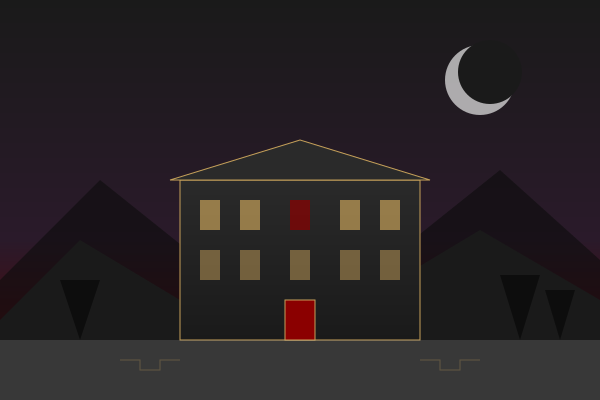
The Overlook Hotel — isolated, opulent, and patient
The Hotel That Remembers
The Overlook Hotel is the second reason The Shining endures, and it may be the most fully realized setting in all of horror literature. King spent weeks researching the Stanley Hotel in Estes Park, Colorado, and the result is a building that feels real — with its history, its staff, its maintenance schedules, its party guests frozen in time. The Overlook is not a vague haunted house. It is a specific place with a specific history of violence, and that specificity is what makes it terrifying.
What King understood — and what so many imitators have missed — is that a haunted building needs to feel like a building before it can feel haunted. We need to believe in the plumbing before we can believe in the ghosts. The Overlook's oppressive architecture, its endless corridors, its history of mob violence and concealed deaths, all create a foundation of dread that the supernatural elements simply build upon.
The hotel wanted him. The hotel needed him. And Danny was the key.Stephen King, The Shining
The Child Who Sees
The third pillar of The Shining's lasting power is Danny Torrance, the five-year-old boy whose psychic abilities — the "shine" of the title — give the reader a window into the hotel's true nature. Danny is the novel's moral center, its innocent witness, and its most tragic figure. He sees what his parents cannot, and his helplessness is the source of the novel's deepest dread.
King's decision to shift perspective between Jack, Wendy, and Danny creates a devastating dramatic irony. We know what Danny knows. We see the hotel through his eyes, in all its rotting glamour. And we watch Jack and Wendy stumble toward a catastrophe that Danny has already foreseen. The reader, like Danny, can see what is coming and cannot stop it.
Why It Still Disturbs Us
Fifty years on, The Shining disturbs us because it is about things that have not changed. Addiction still destroys families. Fathers still fail their children. Isolation still corrodes the mind. The supernatural trappings are the costume; the human heartbreak is the body underneath. King wrote a novel about a man who could not stop himself from hurting the people he loved, and he dressed it in the language of ghosts. But the ghosts were never the point.
What also endures is the prose itself. King was thirty years old when he wrote The Shining, and the book has the energy of a writer hitting full stride. The sentences are muscular and propulsive, and they carry an emotional honesty that his later, more polished work sometimes lacks. There is a rawness to The Shining — a willingness to sit in discomfort — that keeps it from aging. The book does not flinch, and neither can the reader.
The Legacy at Fifty
The Shining's influence is everywhere in contemporary horror. The haunted family drama, the isolated setting as antagonist, the unreliable narrator descending into madness — these are now genre conventions, and they all trace back to King's third novel. Writers from Paul Tremblay to Stephen Graham Jones have acknowledged the debt. The haunted house story, as we know it today, was largely invented in 1977.
But The Shining's deepest legacy may be its insistence that horror is a literary form worthy of serious attention. King wrote a popular novel that also functioned as a serious character study, a meditation on addiction, and a critique of the American myth of self-reliance. He proved that horror could be both terrifying and literate, both commercial and artful. Every serious horror writer working today — whether they admit it or not — is writing in a world that The Shining helped create.
Reading Guide
New to The Shining? Check our reading guide for discussion questions, thematic breakdowns, and a spoiler-safe companion for first-time readers.
At fifty, The Shining is not a museum piece. It is a living book, still capable of surprising a first-time reader and still capable of revealing new layers to someone returning for the fifth or tenth time. It disturbs us because it knows us — our weaknesses, our fears, our capacity for self-destruction. And it knows that the scariest haunted house is not the one with the most ghosts. It is the one that looks, from the outside, exactly like home.