
Shirley Jackson published The Haunting of Hill House in 1959, and the novel immediately established the template that every haunted house story since has followed — including Stephen King's The Shining, which is impossible to imagine without Jackson's precedent. Hill House is the blueprint for modern horror not because it invented the haunted house (that tradition goes back to Horace Walpole and the Gothic novel) but because it redefined what a haunted house story could do. Jackson made the house a psychological mirror, the haunting ambiguous, and the protagonist the true source of terror. Every serious haunted house novel written since 1959 is, in some sense, a response to Hill House.

Hill House: not sane, not straight, not kind
The Opening Sentence
No discussion of Hill House can begin without its opening sentence, one of the most famous in American literature: "No live organism can continue for long to exist sanely under conditions of absolute reality; even larks and katydids are supposed, by some, to dream." Jackson follows this with the lines that define Hill House itself: "Hill House, not sane, stood by itself against its hills, holding darkness within; it had stood so for eighty years and might stand for eighty more. Within, walls continued upright, bricks met neatly, floors were firm, and doors were sensibly shut; silence lay steadily against the wood and stone of Hill House, and whatever walked there, walked alone."
Whatever walked there, walked alone.Shirley Jackson, The Haunting of Hill House
These sentences do everything. They establish the house as a character. They establish the tone — controlled, elegant, quietly terrifying. They establish the central question: what walks there? And they establish Jackson's approach, which is to suggest rather than show. The horror of Hill House is not in what the house does. It is in what the house is.
The Protagonist as Haunted
Eleanor Vance is Jackson's greatest creation, and she is the innovation that separates Hill House from every haunted house story before it. Eleanor is not a victim who stumbles into a haunted house. She is a woman who has been haunted her entire life — by her dead mother, by her guilt, by her isolation, by the thirty-two years she spent caring for an abusive parent. Eleanor arrives at Hill House already broken, and the house recognizes her.
This is Jackson's genius: the haunting is not external. The house does not attack Eleanor. It invites her. It offers her belonging, identity, a home — things she has never had. Eleanor's terror is not that the house will destroy her. Her terror is that the house will keep her, and that she wants to be kept. The novel's tragedy is that Eleanor chooses the house. She walks toward it. She opens the door. The horror is not the ghosts. The horror is the loneliness that makes the ghosts appealing.
The Architecture of Wrongness
Jackson's description of Hill House is masterful in its wrongness. The house is not old and decrepit; it is well-maintained and malevolent. The angles are slightly off. The doors do not hang quite straight. The tower leans. Every detail is just wrong enough to create unease without tipping into cartoonish horror. Jackson understood that the uncanny — the familiar made strange — is more disturbing than the overtly monstrous.
This architectural wrongness influenced Stephen King directly. The Overlook Hotel shares Hill House's commitment to physical specificity, its sense of a building that is not merely haunted but itself alive. King has acknowledged Jackson as a primary influence, and The Shining's structure — a family enters a haunted building that wants one of them — is Hill House's structure transposed to a different key. King made the building bigger and the family more visible. Jackson made the building intimate and the family barely present. Both approaches work. Both trace back to Hill House.
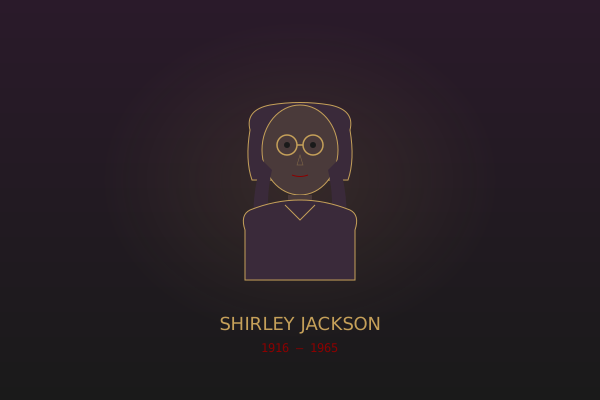
Shirley Jackson (1916-1965)
Jackson's Prose
Jackson's prose is the secret weapon of Hill House. It is controlled, precise, and elegant, with a rhythm that lulls the reader into a false sense of security before delivering a line of pure dread. Jackson does not write for shock. She writes for slow, accumulating unease. The sentences are beautiful, and the beauty makes the horror worse. You cannot dismiss what is beautifully written. You must sit with it.
This literary quality is what separates Hill House from its pulp contemporaries. In 1959, horror was still largely the domain of pulp magazines and cheap paperbacks. Jackson wrote a horror novel that was also a literary novel — a character study, a psychological portrait, a work of art. She proved that horror could be literature, and she did it eighteen years before The Shining. Every literary horror writer working today — Carmen Maria Machado, Victor LaValle, Silvia Moreno-Garcia — is walking a path Jackson cleared.
The Ambiguity
The genius of Hill House is its ambiguity. Is the house actually haunted, or is Eleanor losing her mind? Jackson never tells us. The other characters experience some phenomena, but Eleanor experiences more — and we see the house through Eleanor's perspective. As Eleanor's mental state deteriorates, the reader's trust in her perception erodes. By the end, we do not know what is real. We only know that Eleanor believed it, and that belief was enough to kill her.
This ambiguity is what makes Hill House endlessly re-readable. On a first reading, the house is haunted. On a second, you notice the psychological cues — Eleanor's instability, her need for belonging, her prior breakdown. On a third, you are not sure which reading is correct, and you realize that Jackson has constructed a novel that works either way. The haunting is real if you need it to be. The haunting is madness if you prefer that. The novel does not decide for you. It leaves you alone, in the dark, with the question. That is horror.
Reading Guide
Our Hill House reading guide includes 12 discussion questions exploring the novel's ambiguity, Eleanor's psychology, and Jackson's prose craft.
The Legacy
Hill House's legacy is everywhere. The haunted house as psychological mirror, the protagonist as the true source of haunting, the ambiguity between supernatural and psychological horror — these are now conventions, and they all trace to Jackson's 1959 novel. The Shining, The Haunting of Hill House (Netflix series), The Cabin at the End of the World, Mexican Gothic — all are children of Hill House. Jackson wrote the blueprint, and horror has been building from it ever since.
What endures most is Jackson's insight that the scariest haunted house is the one you choose to enter. Eleanor does not stumble into Hill House. She is invited, and she accepts. She walks through the door because the alternative — her life, her loneliness, her nothing — is worse than whatever waits inside. That is the horror of Hill House. Not the ghosts. The loneliness that makes the ghosts look like home.