
It is a paradox as old as storytelling itself: we deliberately seek out experiences designed to make us feel afraid, anxious, and uncomfortable. We pay money to sit in dark rooms and watch people be terrorized. We spend hours with novels that make us check the locks twice. Why? What is the evolutionary, psychological, and cultural explanation for the human attraction to horror? The answer, it turns out, is not singular. Horror serves multiple psychological functions, and understanding them helps explain why the genre has survived every cultural shift from oral storytelling to streaming.
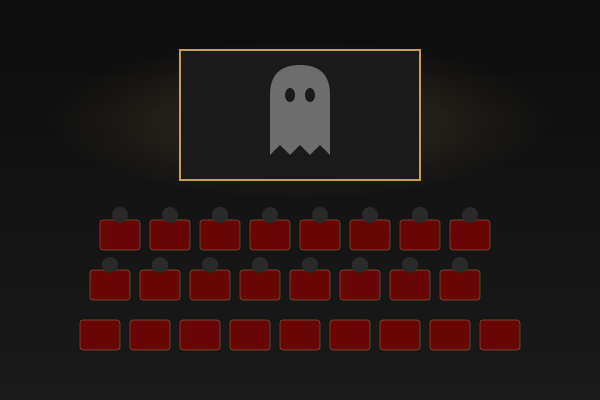
The communal experience of controlled fear
The Safe Danger
The most basic explanation is what psychologists call "safe danger" or "recreational fear." When you watch a horror film or read a horror novel, your body responds as though the threat is real: your heart rate increases, your palms sweat, your breathing quickens. The amygdala — the brain's fear center — fires. But your prefrontal cortex, the reasoning part of the brain, knows you are safe. This gap between physiological fear and cognitive safety produces a kind of thrill that the brain finds rewarding.
Research by Mathias Clasen and other scholars of horror psychology has shown that this simulated fear response can be genuinely enjoyable, similar to the thrill of a roller coaster or extreme sport. The body gets the adrenaline rush of danger without the actual risk. When the story ends and the threat is revealed as fictional, the relief produces a dopamine response. We feel good because we survived something — even if the something was imaginary.
The Evolutionary Argument
Evolutionary psychology offers a deeper explanation. Humans evolved in environments full of genuine threats — predators, hostile tribes, disease, darkness. The ability to simulate threats and rehearse responses would have been adaptive. Horror, in this view, is a form of threat simulation. We engage with fictional danger because our brains are built to practice surviving danger.
This theory explains why horror tropes are cross-cultural: the dark, the predator, the contamination, the loss of self. These are the threats that shaped human evolution, and they appear in horror traditions from every continent. The ghost story, the monster tale, the plague narrative — these are not arbitrary. They are rehearsals for the fears that kept our ancestors alive. We are drawn to horror because our brains think we are training.
We are fascinated by the things that frightened our ancestors, because fascination with threat is itself a survival trait.On evolutionary horror psychology
The Catharsis Hypothesis
Aristotle argued that tragedy produces catharsis — the purging of negative emotions through vicarious experience. Horror functions similarly. We carry anxieties — about death, about violence, about the unknown — that we cannot easily express in daily life. Horror gives those anxieties a shape and a container. By experiencing fear in a controlled context, we process and release it.
This is why horror often becomes more popular during times of social crisis. Horror film attendance spiked during the Great Depression, the Vietnam era, and the post-9/11 period. The horror of fiction allows us to externalize the horror of reality. When the world is frightening, a fictional monster can be a relief — it gives the fear a face, and a face can be fought. Real anxiety is shapeless. Horror gives it shape.
The Curiosity Drive
This curiosity drive is especially strong in adolescence and young adulthood, which explains why horror's core audience has always skewed young. Teenagers use horror to explore mortality, sexuality, and transgression in a safe frame. The slasher film, the haunted house novel — these are rites of passage, ways of confronting adult fears before actually facing adult life. Horror is, in this sense, developmental. It helps us grow up.
The Sensation-Seeking Personality
Not everyone enjoys horror, and psychologists have identified personality traits that predict horror preference. The most significant is "sensation seeking" — a trait characterized by the desire for novel, intense, and stimulating experiences. High sensation-seekers are more likely to enjoy horror, extreme sports, and risky activities. Low sensation-seekers find the same experiences aversive.
Interestingly, research also suggests that horror fans may have lower baseline anxiety than non-fans. The theory is that people who can tolerate and enjoy fear have better emotional regulation around threat stimuli. Horror does not create anxiety in these individuals; it satisfies a need for stimulation that their daily lives do not provide. This contradicts the stereotype of the horror fan as neurotic. The evidence suggests the opposite: horror fans may be psychologically resilient.
The Paradox of Horror
Horror is the only genre defined by a negative emotion. We do not seek out sadness (tragedy), anger (protest literature), or disgust (gross-out comedy) as primary pleasures — but we seek out fear. This makes horror psychologically unique, and uniquely interesting.
The Social Function
Horror is also communal. We watch horror films in groups, we read horror novels and recommend them to friends, we discuss them online. The shared experience of fear creates bonding. Evolutionary psychologists have noted that shared threat response promotes group cohesion — tribes that feared together survived together. Modern horror retains this social function. A horror movie is an excuse to sit close to someone, to grab a hand, to laugh together at the relief when the scare is over.
Horror also serves as a cultural conversation. The best horror is always about something beyond the monster: race (Get Out), class (Parasite), gender (The Babadook), trauma (Hereditary). Horror allows societies to discuss uncomfortable truths through metaphor. The monster is a vessel for anxieties that cannot be addressed directly. This is why horror is often most vital in marginalized communities — it provides a language for experiences that the dominant culture refuses to hear.
Why Horror Endures
Horror endures because fear is permanent. Technology changes, cultures change, but the human brain's response to threat does not. We will always fear death, the dark, the unknown, the loss of self and the ones we love. Horror gives those fears a form — a story, a monster, a narrative that can be experienced, survived, and shared. We are drawn to horror because horror is drawn to us. It knows what we are afraid of, and it is not afraid to show us.