
For roughly fifteen years, from the mid-1970s to the late 1980s, horror was the dominant popular fiction genre in America. It sold in numbers that are now unimaginable. It filled airport book racks, supermarket spinner racks, and pharmacy magazine aisles. It made household names of writers who, in any other era, would have been niche genre figures. This was the Golden Age of Horror Paperbacks, and it was made possible by a combination of technological, economic, and cultural forces that aligned almost perfectly — and then, almost as quickly, fell apart.
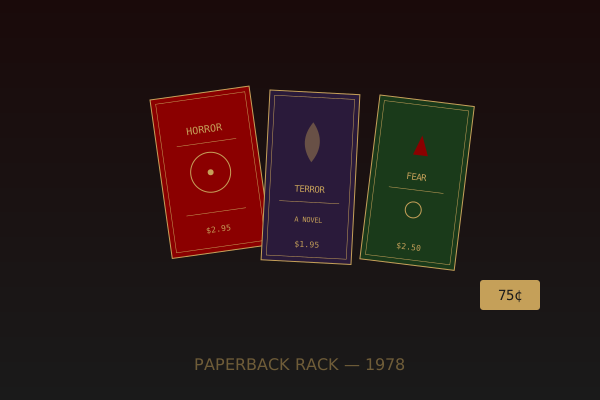
The paperback rack, circa 1978 — where horror lived
The Paperback Revolution
The mass-market paperback had existed since the 1930s, but it was in the 1970s that it became the dominant format for popular fiction. Improvements in printing technology, distribution networks, and retail penetration meant that paperbacks could be produced cheaply, shipped everywhere, and sold in places that had never carried books before. Supermarkets, drugstores, and airports became book outlets. The spinner rack — that rotating display of mass-market paperbacks — was the delivery mechanism for the horror boom.
Paperbacks were cheap enough to impulse-buy, small enough to carry anywhere, and disposable enough that readers did not feel obligated to keep them. This created a culture of voracious consumption. A reader who finished a novel on Friday could buy another on Saturday. Publishers responded by publishing more, faster. The cycle fed itself, and horror — with its compulsive readability and lurid cover art — was the genre that benefited most.
Stephen King as Catalyst
The single most important factor in the horror paperback boom was Stephen King. When Carrie was published in paperback in 1974 and sold a million copies in its first year, publishers noticed. When The Shining, Salem's Lot, and The Stand followed, each selling in the millions, publishers saw a formula. King proved that horror could sell in numbers previously associated only with blockbuster thrillers and romances. He created a market, and the market demanded product.
King's success also changed the perception of horror. Before King, horror was largely associated with pulp magazines, B-movies, and the declining legacy of Lovecraft and Poe. King brought literary ambition, mainstream settings, and contemporary concerns to the genre. He made horror respectable enough for readers who would not have been caught dead with a vampire novel. Once King's readers exhausted his output, they looked for the next thing — and publishers were ready with it.
King opened the door, and a generation of horror writers walked through it.On the King effect
The Authors Who Followed
King's success spawned imitators, but the best of them were genuine talents. Dean Koontz had been writing science fiction and suspense, but in the late 1970s he pivoted to horror and found his audience. Robert McCammon emerged with Baal (1978) and They Thirst (1981), bringing a Southern Gothic sensibility. Peter Straub, already a literary novelist, collaborated with King on The Talisman (1984) and wrote the bestselling Ghost Story (1979). Clive Barker brought visceral, transgressive horror with the Books of Blood (1984-1985). John Farris, Ramsey Campbell, Charles L. Grant, and many others found audiences.
What united these writers was not a single style but a shared marketplace. They were all published in mass-market paperback, marketed to the same readers, and reviewed in the same genre magazines. The paperback horror shelf became a destination. Readers knew where to look, and the shelf was always stocked.
The Covers
The covers of 1970s and 1980s horror paperbacks were their own art form. Before the era of photographic, minimalist design, horror covers were painted — often in oils — by skilled illustrators. The covers featured lurid imagery: haunted houses, demonic faces, blood, fog, isolated figures in peril. They were designed to grab the eye from across a drugstore aisle, and they worked. The cover art of this era — by artists like Boris Vallejo, Rowena Morrill, and others — is now collected and exhibited as a distinct artistic movement.
The horror shelf — always stocked, always tempting
The covers also served a marketing function: they signaled genre instantly. A browser in a supermarket did not need to read the back cover copy to know they were looking at a horror novel. The imagery was a shorthand, and the shorthand created community. Horror readers could find each other through the shared visual language of the covers. The covers were, in a sense, the first horror social network.
The Decline
The Golden Age ended in the late 1980s and early 1990s, killed by a combination of factors. The rise of the big-box bookstore (Borders, Barnes & Noble) shifted retail from mass-market paperbacks to trade paperbacks and hardcovers, which were more profitable but less impulse-buyable. The spinner rack disappeared. Horror's audience, which had been built on cheap, disposable paperbacks, fragmented. Publishers cut their horror lines. Writers who had been midlist stars found themselves without contracts.
At the same time, the quality of the output had declined. The boom had attracted imitators and hacks, and the shelves filled with formulaic, low-quality horror. Readers burned out. The genre that had sold millions began to struggle. By the mid-1990s, horror was declared dead — a premature obituary, but one that reflected a real contraction.
Reading the Era
Want to explore the paperback boom? Our paperback era reading list features 12 essential novels from the 1970s and 1980s, including King, Koontz, Straub, McCammon, and Barker.
The Legacy
The Golden Age of Horror Paperbacks left a permanent mark on the genre. It established horror as a commercial force, created a generation of readers who would pass the habit to their children, and produced a body of work that is still being rediscovered. The current horror boom — led by writers like Paul Tremblay, Stephen Graham Jones, and Silvia Moreno-Garcia — is a direct descendant. The paperback era proved that horror could sustain a mass audience, and that proof has never been forgotten.
The era also left a physical legacy: millions of dog-eared paperbacks, passed between friends, sold at garage sales, collected on shelves. These books are artifacts of a specific moment in publishing history, when horror was everywhere, cheap, and hungry. If you find one in a used bookstore — spine cracked, cover faded, pages yellowed — pick it up. It is a piece of a Golden Age that will not come again. But the books are still here, and the words inside them still work.