
The Overlook Hotel is the most famous haunted building in horror literature, and its fame is earned not through the ghosts that inhabit it but through the way Stephen King makes the building itself a character — a living, malevolent entity with desires, a history, and a will. The Overlook does not merely contain evil. It is evil, and understanding how King achieves this transformation is essential to understanding why The Shining works.
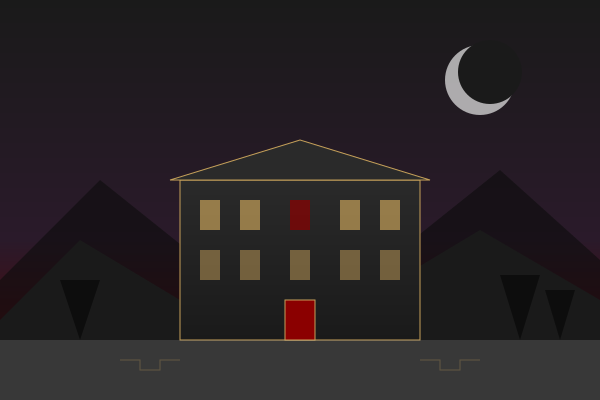
The Overlook: isolated, imposing, patient
A Building With a Biography
From the first pages, King treats the Overlook as a character with a biography. We learn its history: built in 1907 by Robert Townley Watson on a burial ground, funded by mobsters, host to presidents and murderers alike. Each room carries a story. The Presidential Suite holds the ghost of a woman who died in a bathtub. The ballroom remembers the parties of the Roaring Twenties. The basement holds the hotel's financial records — and something else.
This biographical approach is what separates the Overlook from generic haunted houses. King does not simply say "the hotel is haunted." He gives us the specific sins that haunt it: the businessman who shot his family and himself in a suite; the mob hit carried out in the boiler room; the young woman who died by suicide in room 217. Each ghost has a history, and together they form a portrait of American violence — greed, rage, and cruelty accumulated over decades in a single structure.
The Architecture of Dread
King's physical description of the Overlook is precise and deliberate. The hotel has 110 rooms, a ballroom, a lounge, a basement with old ledgers, a roof with a view of the mountains, and — crucially — a hedge maze. The layout matters because King uses it to create a geography of dread. The Torrance family moves through the hotel's spaces, and each space carries its own threat.
The basement is where Jack encounters the hotel's financial rot and its supernatural heart. Room 217 is where Danny first confronts the hotel's ghosts directly. The ballroom is where Jack is seduced by the illusion of hospitality — the ghostly party that welcomes him with open arms. The hedge maze is where the novel's climax plays out, a physical manifestation of the mental labyrinth Jack has been lost in all along.
This inhuman place made human monsters.Stephen King, The Shining
The Hotel Wants
What makes the Overlook a character rather than merely a setting is that it has desires. The hotel wants Danny's power — his "shine." It has been waiting for someone like Danny, someone whose psychic abilities can feed its hunger and amplify its power. The hotel is not passive evil; it is active, strategic, patient. It lures the Torrance family in with the promise of isolation and employment, then it goes to work.
King's genius is in showing how the hotel operates through Jack rather than on him. The Overlook does not possess Jack outright; it finds his vulnerabilities — his alcoholism, his rage at his students and his family, his frustrated literary ambitions — and offers him what he wants most: recognition, validation, and drink. The hotel understands Jack better than Jack understands himself, and it uses that understanding to turn him into a weapon against his own son.
The Moving Hedge Animals
One of King's most unsettling inventions in the novel is the hedge maze — not the simple geometric maze of Kubrick's film, but a collection of topiary animals that come alive. The lions, the rabbits, the dog — they move when you are not looking, inching closer, changing position. King describes this with a restraint that makes it terrifying: a lion that was facing left is now facing right. The distance between the animals and the viewer has decreased. Nothing happens overtly. The horror is in the implication.
The hedge animals are a perfect metaphor for the hotel itself. The Overlook does not leap at you. It creeps. It changes position when you look away. It is patient, and it is always closer than you think.
Setting as Mirror
Beyond its role as antagonist, the Overlook functions as a mirror for its inhabitants. The hotel shows people what they fear most and what they desire most. For Jack, it offers literary success and the validation of powerful men. For Wendy, it reflects her fear of her husband's violence. For Danny, it reveals the dark future he can see but cannot prevent.
This mirroring function is what elevates the Overlook above mere haunted house. The hotel is not simply evil; it is a projection of the evils its inhabitants bring with them. The ghosts in the hotel are real, but they feed on the weaknesses of the living. Without Jack's alcoholism, the hotel's bar would be empty. Without Danny's shine, the hotel would have no reason to wake up. The Overlook is a parasite that requires a specific host, and the Torrance family — with all their pain and power — is exactly what it needs.
Deep Dive
For a deeper look at how The Shining compares to other haunted house novels, see our analysis of Shirley Jackson's Hill House, the blueprint that King built upon.
The Legacy of the Overlook
The Overlook Hotel established a template that horror has been copying ever since: the isolated building as sentient antagonist. From Marisha Enzlberger's haunted apartment buildings to the sentient houses of Shirley Jackson and Anne Rivers Siddons, the tradition of the building-as-character traces directly back to King's third novel. But few have matched the Overlook's specificity, its history, its patience, its hunger.
The Overlook endures because it is not a metaphor. It is a place — a place with plumbing and ledgers and a boiler that needs watching, a place that also happens to be alive and malevolent. King understood that horror needs grounding in the physical and the mundane. The hotel must feel like a hotel before it can feel like a monster. And the Overlook, for all its ghosts, feels more real than any building you have ever stayed in. That is why it still frightens us. It is too real to dismiss, and too evil to survive.